Rainbow Map 2026 Shows No Significant Progress in LGBTI+ Rights in the Republic of North Macedonia

On the occasion of May 17 – the International Day Against Homophobia, Biphobia and Transphobia, ILGA-Europe published the Rainbow Map 2026, assessing the state of LGBTI+ human rights across Europe.
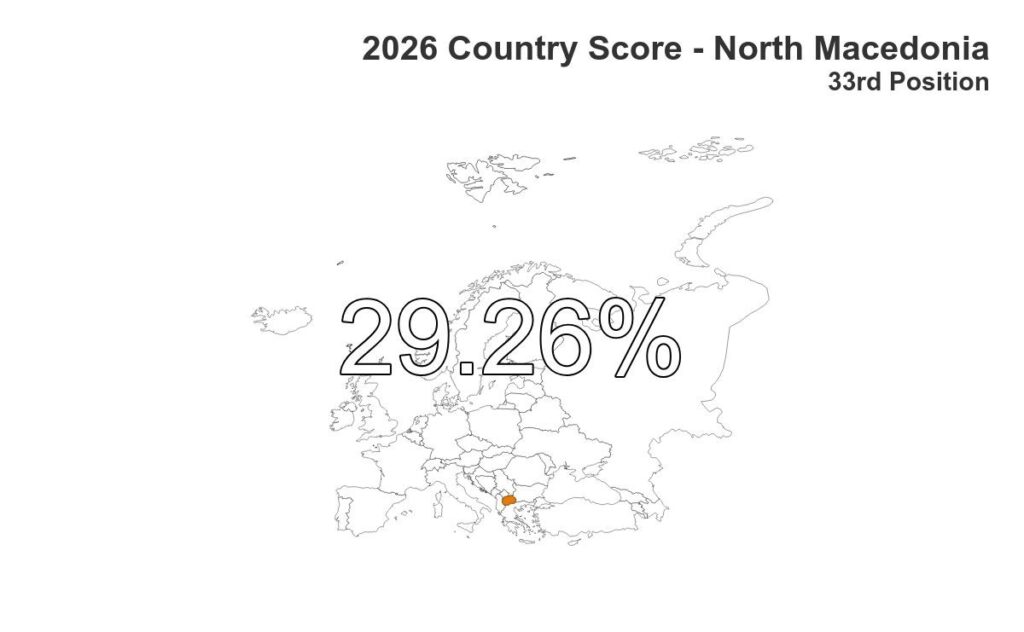
Over the past five years, the Republic of North Macedonia has seen little to no significant progress. The country has consistently remained around 30th place out of 49 countries, with a score that has stagnated between 27% and 31%. Meanwhile, several countries in the region, such as Slovenia (18th place), Montenegro (20th place), Croatia (21st place), Bosnia and Herzegovina (25th place), and Serbia (28th place), rank higher than North Macedonia, which is positioned in 33rd place.
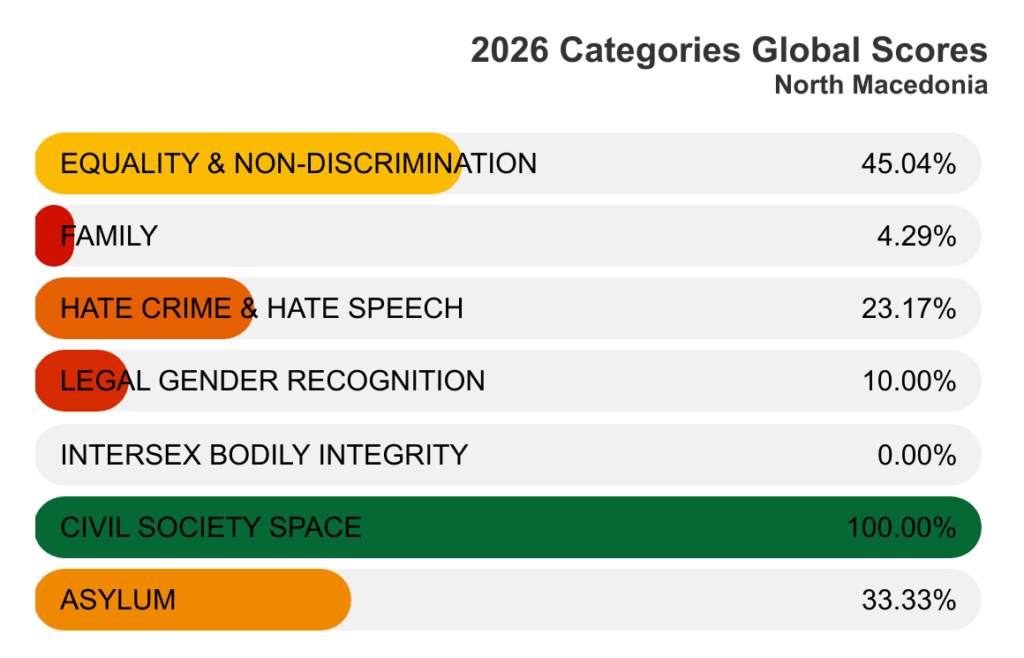
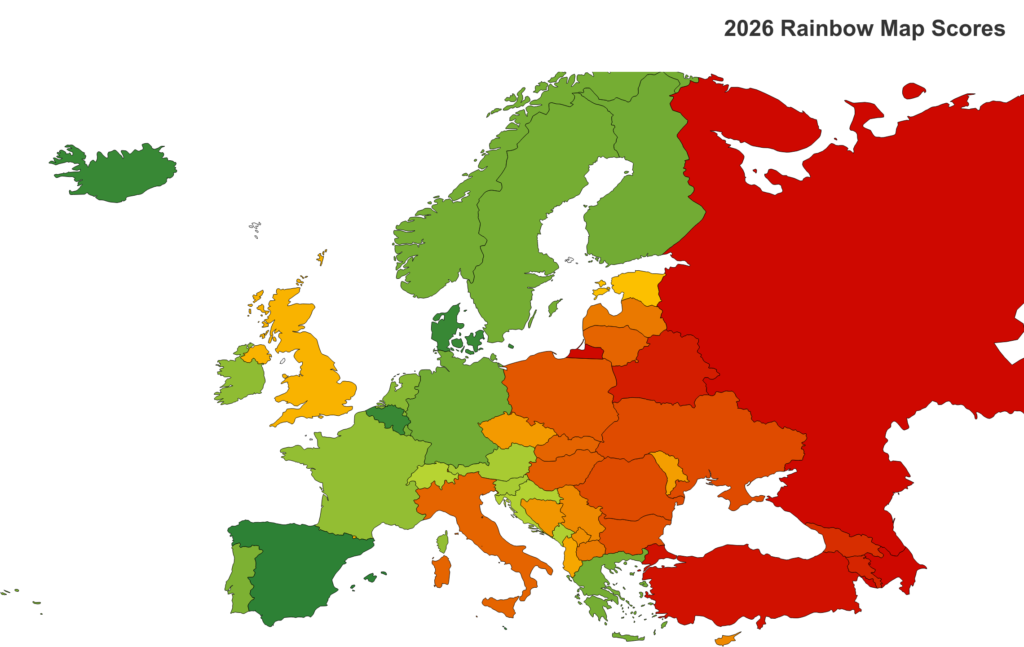
Archive: Ilga Europe
Although certain anti-discrimination protection mechanisms exist on paper, the reality for transgender people continues to be marked by institutional barriers, legal uncertainty, and daily exposure to hate speech, discrimination, and stigma.
For many, these are just percentages and rankings. For us, these are real lives. These are people who live every day fearing whether they will be insulted or attacked in the street, whether they will receive adequate healthcare, whether institutions will recognize them, and whether they will be able to live with dignity as who they truly are.
Particularly concerning is the fact that the Republic of North Macedonia still lacks a functional system for legal gender recognition based on self-determination. Despite the judgment “X. v. the former Yugoslav Republic of Macedonia,” issued by the European Court of Human Rights (ECtHR) in 2019, which obligated the state to establish a clear, accessible, and swift procedure for legal gender recognition, there has been no substantial progress in this process to date.
Although a draft law on legal gender recognition was submitted for the third time in 2023 by seven women MPs, it was never placed on the parliamentary agenda for adoption. This further demonstrates the lack of political will and institutional commitment to addressing this issue, leaving trans people without legal certainty, dignity, and equal access to fundamental human rights.
In recent years, we have also witnessed an increase in hate speech directed at the trans community, disinformation in the media and on social networks, institutional silence, a lack of adequate healthcare and psychological support, as well as the continued marginalization and invisibility of trans people in public policies.
Despite all of this, the trans community in the Republic of North Macedonia has not stopped organizing, supporting one another, and fighting for its rights. Over the past five years, marches, trainings, the jubilee 10th Transpozium (a regional event for the trans community in the Balkans), support groups, free legal and psychological assistance, and numerous community-led initiatives have been organized.
This Rainbow Map is not merely a ranking. It is a reminder that trans people in North Macedonia still do not have equal access to dignity, safety, and fundamental human rights.