November 20 – International Transgender Day of Remembrance, Honoring the Lives of Transgender People Lost to Transphobic Violence
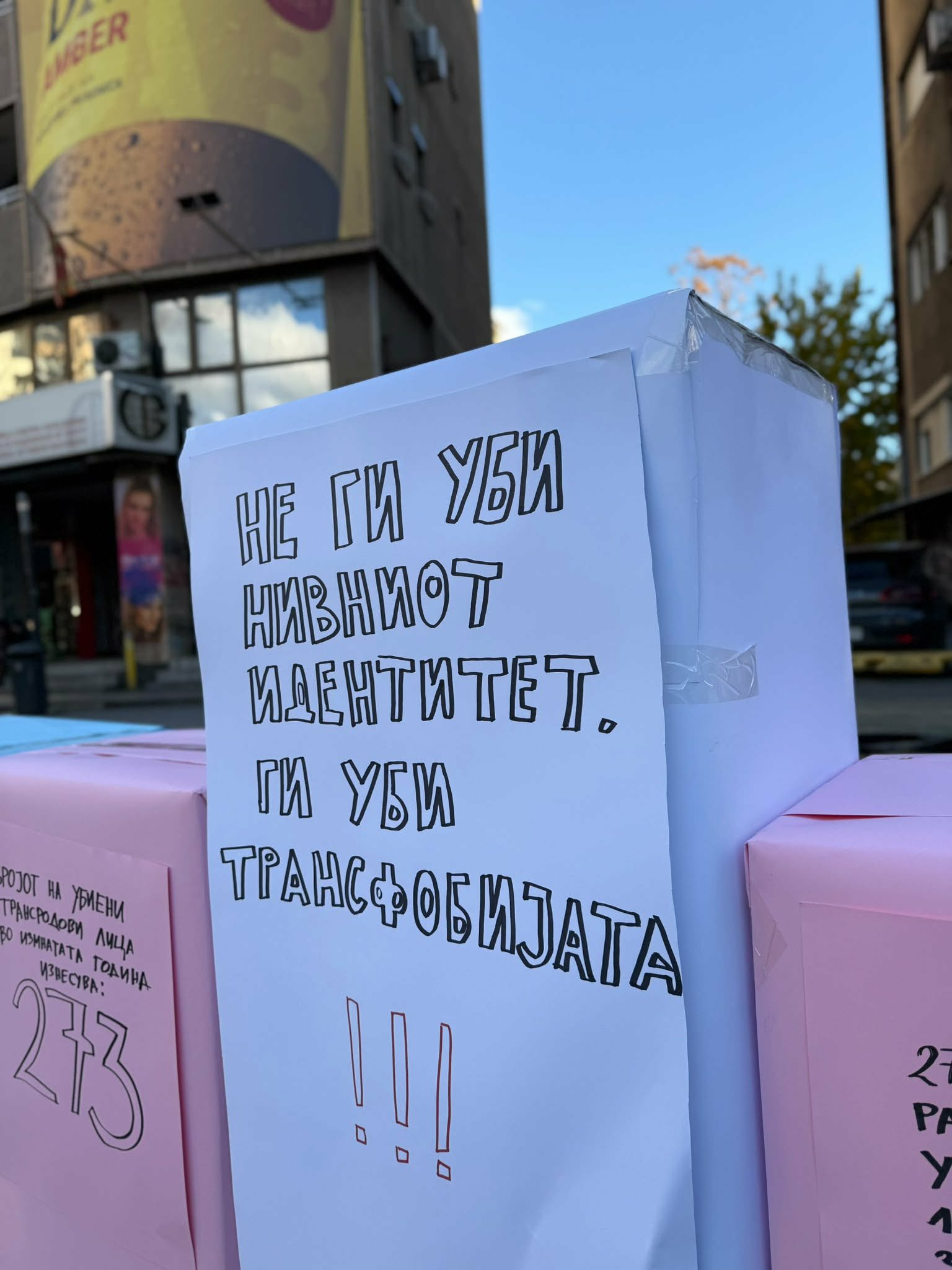
Today, we remember the transgender people whose lives were taken as a result of transphobia and hatred. Remembrance is not simply about naming the victims. It also means recognising the social and political conditions that make violence against transgender people possible.
According to TGEU’s latest report, between October 2025 and September 2026, 273 murders of transgender and gender-diverse people were recorded worldwide. This means that, on average, one person was murdered every 32 hours. As many as 95% of the victims were trans women and transfeminine people.
North Macedonia is no exception to this reality. Transgender people are increasingly confronted with stigma, discrimination, public humiliation and institutional barriers and. Particularly alarming is the harm caused by anti-gender actors, who have created an environment in which the very existence of transgender people is framed as something threatening.
At a time when North Macedonia is facing an alarming number of femicides and the outright demonisation of feminism, it is more important than ever to recognise those who normalise control and violence against people on the basis of their sex and gender identity. Patriarchal structures endanger both women and transgender people, in different but deeply interconnected ways.
We must not speak only about the victims, but also about the responsibility of institutions and politicians. Violence never begins with the final act. It begins much earlier, through hate speech, propaganda, dehumanisation, discrimination, and the silence of those who have the power to act.
We remember the transgender people whose lives were taken, and we insist on the right of those who are still alive to exist and live like everyone else, without having to justify their very existence.
“ The ‘We Are Here’ project, implemented by TransFormА, is carried out within the framework of the FIER·ES project, coordinated by ERIM and implemented in partnership with ERA, with financial support from the French Development Agency (AFD).”
“This material has been produced with the support of the French Development Agency (AFD). The ideas and opinions expressed herein are those of the authors and do not necessarily reflect the views of the French Development Agency (AFD).”